
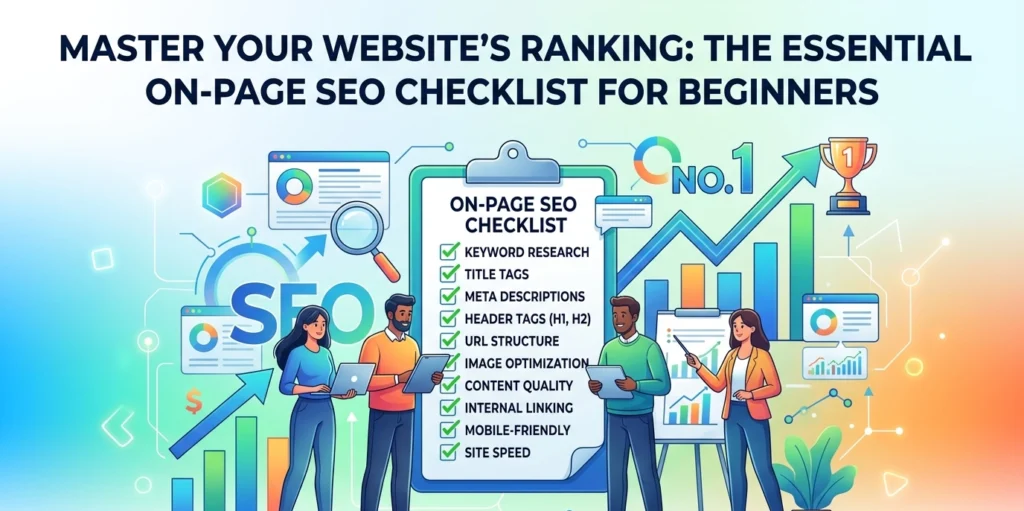
Master Your Website’s Ranking: The Essential On-Page SEO Checklist for Beginners
As a business owner, you’re constantly seeking ways to grow your reach and attract more customers. If you’re looking to improve your website’s visibility on Google without a massive budget, mastering on-page SEO is your crucial first step. It’s about optimizing individual web pages to rank higher and earn more relevant traffic in search engines. I’m Shameer Ali, a freelance digital marketing analyst based in Malappuram, and I’m here to simplify the process for you. This actionable checklist will guide you through the fundamental elements you need to tackle to get your pages noticed.
What Exactly is On-Page SEO and Why Does It Matter for My Business?
On-page SEO refers to all the optimization efforts you make directly on your website pages. This includes elements like your content, title tags, internal links, images, and more. Think of it as making your website as appealing and understandable as possible, not just for your human visitors, but also for search engine bots. When Google’s crawlers visit your page, they look for specific signals to understand what your content is about and how valuable it is to users. Without strong on-page optimization, even the most brilliant content might remain hidden in the depths of search results, meaning missed opportunities and lost customers for your business.
How Do I Conduct Keyword Research for On-Page SEO?
Before you even begin optimizing, you need to know what your target audience is searching for. Keyword research is the foundation of effective on-page SEO. Start by brainstorming terms related to your products or services. Then, use tools like Google Keyword Planner (free), Ubersuggest, or SEMrush to find related keywords, check their search volume, and assess their competitiveness. Focus on a primary keyword for each page, and identify a few secondary keywords that support the main topic. Remember, the goal isn’t just high-volume keywords, but relevant keywords that bring qualified visitors ready to convert.
What Are the Key Elements of an On-Page SEO Checklist?
Here’s a practical, step-by-step checklist to optimize your web pages:
1. Title Tags & Meta Descriptions: Your First Impression
- Title Tag: This is arguably the most important on-page element. It’s the clickable headline that appears in search results.
- Include your primary keyword naturally, ideally near the beginning.
- Keep it concise (around 50-60 characters) to avoid truncation.
- Make it compelling and accurately reflect the page’s content.
- Meta Description: This is the short summary that appears under your title tag in search results.
- Include your primary and secondary keywords.
- Write a compelling, unique description that encourages clicks (a mini-ad for your page).
- Keep it under 155 characters to ensure it displays fully.
2. Header Tags (H1, H2, H3): Structuring Your Content
- H1 Tag: Each page should have only one H1 tag, serving as the main heading. It should typically be similar to your title tag and include your primary keyword.
- H2/H3 Tags: Use these to break down your content into digestible sections. Include secondary keywords in these subheadings to provide more context to search engines and improve readability for users.
3. High-Quality Content: The Heart of Your Page
- Originality & Depth: Create unique, valuable, and comprehensive content that genuinely answers user queries. Aim for depth over superficiality.
- Keyword Integration: Naturally weave your primary and secondary keywords throughout your content. Avoid keyword stuffing – it harms readability and can lead to penalties.
- Readability: Use short paragraphs, bullet points, and clear language. Aim for a reading level that’s accessible to your target audience.
4. Image Optimization: More Than Just Pretty Pictures
- File Names: Name your image files descriptively with relevant keywords (e.g.,
on-page-seo-checklist.jpg). - Alt Text: Provide descriptive alt text for every image. This helps search engines understand image content and improves accessibility for visually impaired users. Include keywords where natural.
- Compression: Compress images to reduce file size without sacrificing quality. Faster loading images improve page speed.
5. URL Structure: Keep it Clean and Simple
- Create short, descriptive URLs that include your primary keyword.
- Use hyphens to separate words (e.g.,
yourwebsite.com/on-page-seo-checklist). - Avoid jargon, numbers, or complicated characters where possible.
6. Internal Linking: Guiding Your Users and Google
- Link to other relevant pages within your website. This helps distribute “link equity,” improves user navigation, and keeps visitors on your site longer.
- Use descriptive anchor text (the clickable text) that includes keywords relevant to the linked page. For example, if you offer various digital marketing services, you might link to your SEO service page or your Google Ads management solutions from related content.
7. External Linking: Building Trust
- Link out to high-authority, reputable websites when you reference statistics, studies, or external resources. This adds credibility to your content.
8. Mobile-Friendliness & Page Speed: User Experience is Key
- Mobile Responsiveness: Ensure your website looks and functions perfectly on all devices – desktops, tablets, and smartphones. Google prioritizes mobile-first indexing.
- Page Speed: Optimize your website for fast loading times. Use tools like Google PageSpeed Insights to identify and fix issues. Slow pages frustrate users and negatively impact rankings.
Implementing these on-page SEO tactics might seem like a lot at first, but each step contributes significantly to your overall search performance. I often help local businesses in my role as a digital marketing analyst in Malappuram, and I’ve seen firsthand the powerful impact these fundamental optimizations can have.
Ready to implement these strategies but need a guiding hand to ensure you’re doing it right and seeing real results?
Book a Free On-Page SEO Strategy Call – Currently accepting 3 new clients for May!
Why is Consistent On-Page Optimization a Game-Changer?
Think of your website as a physical storefront. On-page SEO is like arranging your products neatly, labeling them clearly, and making sure your store is easy to navigate and aesthetically pleasing. Consistent optimization ensures that search engines always have the clearest picture of what your website offers, leading to higher rankings, more organic traffic, and ultimately, more customers for your business. It’s not a one-time task; it’s an ongoing effort that yields compounding returns.
Don’t let your competitors steal your customers because your website isn’t optimized. Take control of your online presence today.
Get Your Website Optimized: Book a Free Strategy Call Now!
Frequently Asked Questions About On-Page SEO
- What is the main difference between on-page and off-page SEO?
- On-page SEO refers to optimizing elements directly on your website (content, keywords, titles, internal links). Off-page SEO involves activities done outside your website to improve its ranking, primarily through building backlinks from other reputable sites and social media signals.
- How long does it take to see results from on-page SEO?
- While results vary based on competition and the quality of implementation, you can often start seeing initial improvements in rankings and traffic within a few weeks to a few months. Consistent effort and monitoring are key to long-term success.
- Can I do on-page SEO myself, or do I need an expert?
- Many basic on-page SEO tasks can be done by business owners, especially with a clear checklist like this one. However, for more complex technical SEO, advanced keyword strategy, or if you lack the time, hiring an SEO expert can significantly accelerate your progress and ensure best practices are followed.
- How often should I review my on-page SEO?
- It’s advisable to conduct a full on-page SEO audit at least once or twice a year. However, for active content pages, you should review and update them regularly (e.g., quarterly) to ensure content remains fresh, keywords are still relevant, and any new SEO best practices are incorporated.